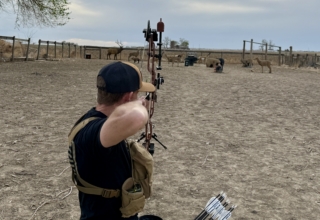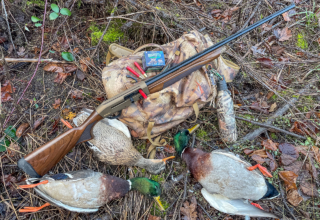
Columbia black-tailed deer occupy some of North America’s most dense habitat. Hunting them in the Coast Range could be the toughest of all.
by Scott Haugen
The afternoon before a group of four hunters arrived, Jody Smith and I split up. We were searching for Columbia black-tailed deer in Oregon’s Coast Range. Smith went high into the hills looking for a nice 3×4 we’d caught on a trail camera but never actually laid eyes on. I headed towards the mountains overlooking the Pacific Ocean, hoping to locate a big, heavy 3×3 we’d been chasing for two seasons.
“Whatdya see?” I asked Smith when we met up back at the cabin. It was well after dark. He was building a fire. “Two does is all,” he snickered. “You?” “One of the biggest coastal bucks I’ve ever seen, I think.” “You think?“ Smith asked, looking confused.
I went on to describe the buck. How, when it emerged from the timber, its massive chest and dark color took my breath away. When you lay eyes on a true giant of any species, you instantly know it. At over 800 yards away in waning daylight, I could see the rack was tall and heavy. How many points it carried, I hadn’t a clue. But the image of the deep chest and stately strides wouldn’t leave my mind. It was a magnificent deer.
The Ground Work
When the hunters arrived, Smith went over the details. Jody Smith is a full-time guide based out of Elkton, Oregon. We’ve known one another for over 25 years. He’s one of the finest, hardest-working men I’ve ever met. He’s positive and highly successful in all he does. And he loves hunting blacktails.
I spend a lot of time with Smith, helping when and where I can. I do it mainly for the company; he doesn’t really need my help. Not many folks are on the same page as I am. Smith is. The outdoors is our happy place. Together, we have over 50 trail cameras set in the area we were hunting. They’re up year-round. This time of year blacktails, Roosevelt elk, and black bears are the primary targets. Mountain lions, bobcats, and coyotes also frequently appear on camera.
By July, we’re seriously scouting the area for bucks and bulls in velvet, both on trail cameras and with our eyes. It’s common to see more mature blacktails in a single day of summer scouting than during an entire season of hunting for them. The country is rugged, with jungle-like terrain. Many who’ve come to hunt the Coast Range for the first time say it’s the most challenging terrain they’ve set foot in in North America.
Once bucks strip their velvet in late August, they almost instantly turn nocturnal. Catching them in the open is the challenge. Columbia blacktails are masters of camouflage, blending in so well that even the best-trained eyes get fooled. Quality glass is a must. You’ll spend more time searching with your glass than hiking blindly through the mountains.
I spent hours every day looking through my new Leupold BX-4 Pro Guide HD 10×42 binoculars. I rank these the best Leupold binos I’ve used. The glass clarity is tops, the eye cups are comfortable and stable. They’re made for blacktail hunters.
The Knowles Buck
The camp was a unique one. A selection of some of the finest men in the hunting industry. Friends, all of us. While I didn’t have a tag, the pressure was still there, maybe more so because I know how hard it is to kill a big blacktail, let alone four. Smith has had 100 percent shot opportunities on his guided blacktail hunts over the years. But he usually has one or two hunters in camp, not four.
The first morning, Smith dropped two hunters on ridge tops to glass clearcuts. He took another back into the draw where the nice 3×4 had eluded us. I took Skip Knowles to look for the monster buck I’d seen the evening prior.
Knowles has been in the industry for decades. He’s the editor of Wildfowl and Predator Nation magazines, and the recently discontinued North American Elk. I’ve been writing for him for years. In my 28-year writing career, no editor has pushed me or made me want to improve more than Knowles. He’s passionate about the hunt and how it’s portrayed in words. He appreciates quality photos and pushes writers to give their best, always. A few years ago, I considered retiring. Knowles rekindled my career, pumping life back into my veins. I wouldn’t have been in this camp were it not for him.
Knowles grew up in the Pacific Northwest, among other parts of the country. He hunted blacktails as a young man. It was our goal to chase these grand deer together. The time was now.
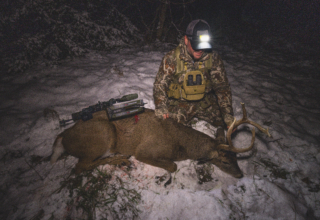
After more than an hour of searching for the big buck and seeing only two does, we headed to the backside of the ridge. Hiking down an old logging road, I peeked over the edge. A gray muzzle and white throat patch instantly caught my eye. The buck was standing on the edge of a thick forest. Knowles was quick to get his rifle in the shooting sticks. “174 yards,“ I whispered as he settled in. “It’s not the big buck, but it’s mature, a three-point at least,“ I said. Knowles knew what he wanted.
At the shot, the buck crumpled, then cartwheeled down the ridge. The pack-out wasn’t easy or quick. We were in no rush. Knowles was shooting a Browning X-Bolt 2 Speed in 7 PRC with 175-grain ELD-X Hornady bullets. He’d taken several big game animals with this bullet. This was his first Columbia blacktail with the setup.

We exchanged high-fives and hugs. It all happened fast, the shot and the hugs. I was elated to share a special morning with this man.
The Darby Buck
That afternoon, David Draper shot his first Columbia blacktail deer. It was a representative 3×3 that held tight in a blackberry thicket. The shot came at 30 yards. Blacktail bucks often hunker down like cottontails. There are no set rules when hunting these deer.
I’ve known Draper for years, well before he became the editor of Petersen’s Hunting, one of the most respected magazine titles on the planet. He and my wife, Tiffany, worked on many wildlife cooking projects back in the day. He’s one of the most well-rounded outdoorsmen I know. He appreciates the little things. I’d hunt with him anytime, anywhere, for anything.

The day after taking his buck, Draper spotted some chicken of the woods mushrooms growing on a stump. He wanted to hike down and get them. “Darby, that’s ten times farther than what you shot your buck at. You sure you want to hike all that way for a fungus?“ Smith snickered. Smith nicknamed him Darby. Not sure why, but it stuck.
“You guys head down right here and I’ll pick ya up at the bottom,“ Smith said as he shook his head and brought the side-by-side to a stop. Darby and I carved mushrooms from the dead stump. They oozed juices that smelled like fresh, cleaned, raw chicken. Darby cooked up fresh tenderloin and mushrooms for dinner. We feasted like kings. It was the best wild mushrooms I’ve ever had. Darby agreed.
Darby took his buck with Mackenzie Smith, Jody’s son. I’ve known Mac’ since he was in grade school. It’s been fun watching him grow into a fine hunter, devoted husband, and father. One night, everyone turned in early. Mac’ and I started talking blacktails. We stayed up into the wee morning hours, talking about our favorite animal in the world to hunt. Like his dad, Mac’ is a next-level hunter. Those hours, talking blacktails with Mac’, were one of the greatest moments of the hunt for me. It’s so rewarding to watch one of your best friends’ kids turn out so good. It warmed my heart.
Double Time
The following day found clear skies and temperatures climbing near 70 degrees; hot for late October in the Coast Range. With two tags left to fill, we didn’t see a buck all morning. But Rafe Nielsen made a heckuva shot—480 yards—on his first Oregon black bear.
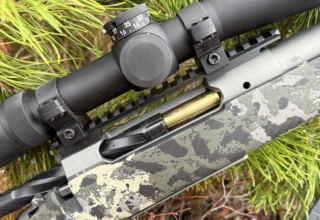
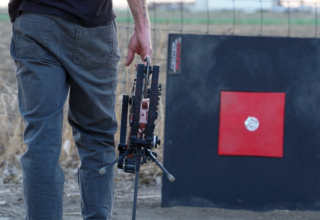
The bear fed on grass on the edge of a creek bottom. Nielsen got prone, dialed the CDS on his Leupold VX-5HD Gen 2 scope, and made a perfect shot with his 6.8 Western. If you’ve not used Leupold’s Custom Dial System (CDS), it’s a tool to consider because it takes the guesswork out of longer shots, resulting in confident, pinpoint accuracy.

The following morning, Nielsen, Jody, and I headed to the edge of the Elliot State Forest in search of the 3×4. Smith started catching the buck on a trail camera in August. It regularly followed the same path every few days until late September, then it vanished. During all of our scouting time, we never saw the buck, and not since late August had the buck been caught on a trail camera in daylight. Then it appeared on camera on day two of the hunt.
We approached the area from the bottom of a canyon. That’s when Smith noticed buck tracks along the roadside. They were fresh and filled with water. It had been pouring that morning. A coastal rainstorm would fill tracks in seconds.
“Let’s back out and see if we can get above it,” Smith said. “It’s got to be headed into that big clearing, back toward the forest.”
Smith parked the side-by-side on the edge of a logging road. We walked to the end of an old landing that overlooked a five-year-old clear-cut on the edge of the Elliot. We scrolled the land below as we inched forward, tediously searching for any parts of a deer. Then Smith spotted a buck.
Nielsen quickly crawled forward, rested his rifle on his pack, and was rock solid. “204,“ Smith whispered. There was no discussion. It was a shooter buck, and we knew it.
Nielsen made a perfect shot with the 6.8 Western, a caliber that’s in my top three all-around big-game calibers for North America and even Africa. Shooting Browning’s 175-grain Long Range Pro Sierra Tipped Gameking bullets, this load has more energy at 500 yards and beyond than most factory loads in a .300 Win. Mag. Combine that with the 6.8’s faster twist, the use of less powder to make room for a longer, sleeker, heavier bullet, and you get one of the most impressive performing calibers I’ve shot.

I’ve taken several animals with it, including elk and bear, as well as sable and roan in Africa. I’ve seen over 30 big game animals shot with it. There’s a reason I own one.
Not until we walked up to Nielsen’s blacktail, his first ever, did Smith and I recognize it. It was the 3×4 we’d caught on Stealth Cameras throughout the summer. It was the first time we’d laid eyes on it. The buck was gorgeous; one worthy of the wall. It will look stunning in Nielsen’s bedroom, but I bet it ends up in his office at Browning’s headquarters in Utah. Smith’s move to get ahead of the tracks we saw at the bottom of the canyon paid off. The fact that the buck was glued to two does helped.
The Skipper Buck
Nielsen’s buck was the first sign of blacktail rutting activity during the hunt. It was October 19th. “They’re four or five days late this year,“ Smith noted, referring to the rut. The coastal blacktail rut typically commences sooner than in the Cascades or valley floors.
Every morning and evening, someone in the group was glassing for the big buck I had seen the evening before their arrival. No bucks were seen over the next day and a half.
“Tomorrow could be the morning for him to show,” Smith commented at dinner. “There have been a few does in that unit, and the temperature is dropping a lot tonight.”
On the last morning of the hunt, everyone spread out. Shawn Skipper held the final tag in the group. Skipper is well known in the hunting industry, has been for many years. He’s Leupold’s Manager of Media and Shooting. In other words, he organizes and hosts many cool hunts worldwide. He’s also usually the last to get on the trigger. This often sees him settling for any animal, as taking care of others is his priority. He’s one of the most generous men you’ll meet. He deserved what was about to transpire.
Smith and Skipper were in position at daylight, glassing the steep mountainside where the big buck had been six days prior. They scoured the timbered edges first but saw nothing. Ten minutes later, Smith spotted a doe 200 yards into the unit. Then another doe, then a buck.
“I was surprised how far they were from the timberline,” recalls Smith. “I knew the buck was big, but didn’t know how big until it turned sideways. I’ll never forget the mass and height of that rack. It was just incredible.”
Skipper laid down, extended the legs of his Magpul bipod, and centered the FireDot on the buck’s chest. It was facing him. “I didn’t want to wait and risk it turning because, one step either way, and the surrounding brush would have swallowed the buck up,“ Skipper shared.

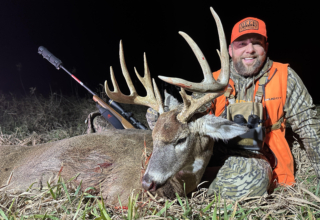
Skipper is a crack shot. He cranked the scope to 15x to thread the needle between brush and small fir trees that were encroaching on each side of the buck. The 214-yard frontal shot was simple for him. A 212-grain ELD-X fired from his Browning .300 PRC dropped the buck. And what a buck it was. One of the biggest I’ve seen come from the Coast Range, both in body and antler. It was with two does, which proved to be its downfall.
Three and a half hours of packing ensued up the steep mountain. With the boned-out deer, along with the head and cape, back at camp, everyone was in awe. Finally, the man who lets everyone else shoot the big ones got his turn. On this day, the blacktail gods smiled on Shawn Skipper, as they did on every hunter in the group during a week of hunting the most excellent deer on the planet. It was a time none of us will forget. Ever.
Note: Fewer than 75 copies of Scott Haugen’s best-selling book, Trophy Blacktails: The Science Of The Hunt, remain. Visit scotthaugen.com to get your signed copy.