Discover the Rocky Talkie Expedition 5W Radio, offering reliable communication and NOAA weather access for safer hunting in remote areas
by Scott Haugen
What do remote Alaska, duck hunting from a layout boat in a windy bay, torrential downpours, big timbered canyons in the Pacific Northwest, the rugged back country, a long drive through badlands, and places within sight of major metropolitan areas have in common?
Not all of them offer cell phone coverage. If you want or need to be in contact with someone, that can be an issue, even life-threatening.
This past spring, I called in and shot a cougar in a thickly forested area a few miles from my home. I whipped out my cell phone to notify my wife. I had zero coverage. We’d just switched cell phone carriers a few days prior. I had to drive halfway home before I could text her to let her know I was going to be a while. Frustrating.
Then again, for those of us who grew up hunting in the 1970s, not communicating with friends or family members while afield was normal.
“No news is good news” was what my wife and I lived by. Communication options were available back then, but they were primitive and had many limitations.
Today, most handheld radios function as they did 60 years ago. These 2W home radios are fine around camp, when in line of sight with one another, or less than a mile from the person you’re talking to. But the Rocky Talkie Expedition 5 Watt Radio has taken communication to another level.
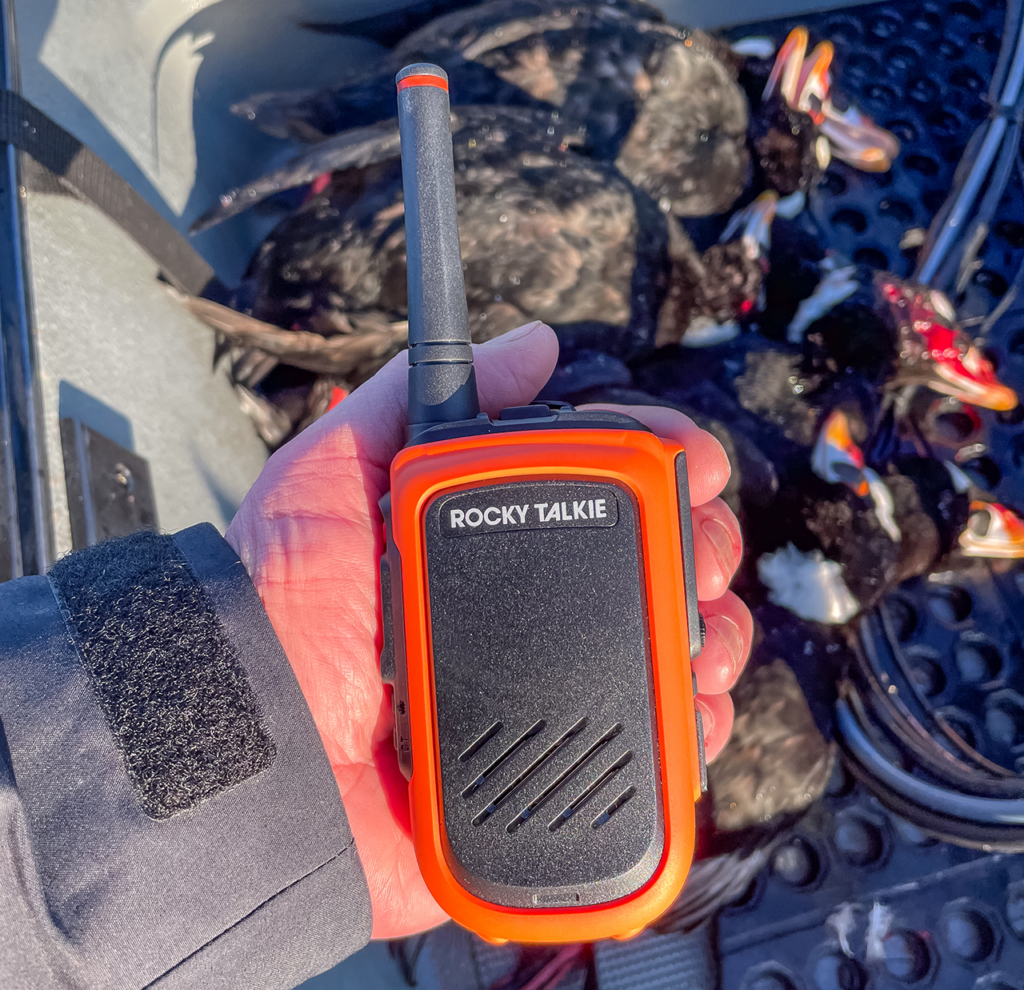
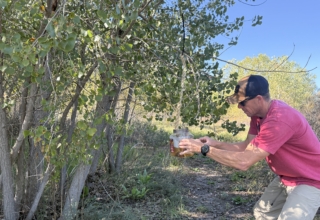
Last winter, I was checking trail cameras in a rugged canyon in the Coast Range. A buddy dropped me off. As usual, he was going to pick me up at the bottom, two hours later.
But when I encountered several fallen trees, some of which buried trail cameras, I knew it was going to be a long day. Using the Expedition radio, I got in touch with my friend. I kept him updated. Five hours later, he picked me up. There was no cell coverage, no other way to communicate. Had we not had the Expedition radios with the UHF antenna, it would have been a very inconvenient situation.
I used the Expedition radio on multiple waterfowl hunts last season. In rainy, windy conditions, and when hunting saltwater bays, where cell phones weren’t an option. They worked without a glitch. Even in windy, rainy conditions, the sound quality and volume surpassed any walkie-talkie I’ve used. On one hunt in a layout boat, it was blowing hard. Saltwater ripped over the edges and repeatedly hammered me in the face. Everything got soaked. But the sea ducks were decoying in picture-perfect fashion. The mothership that dropped me off was going to return in an hour. I called them on the Expedition Radio 12 minutes into the hunt. I’d shot my limit and wanted to get out of the layout boat. Things were getting risky.

My radio took a pounding that brief morning, yet worked perfectly. A quick rinse in fresh water once back in the big boat is all I did, and it’s continued working with precision.
The Rocky Talkie Expedition 5 Watt Radio is a General Mobile Radio Service (GMRS) radio, which means you need a FederalCommunications Commission (FCC) license to use it. It’s straightforward to get and no tests are necessary. Simply register your device online, pay $35, and it’s good for the whole family for 10 years. This licensing requirement allows the FCC to better regulate the frequencies used by two-way radios.
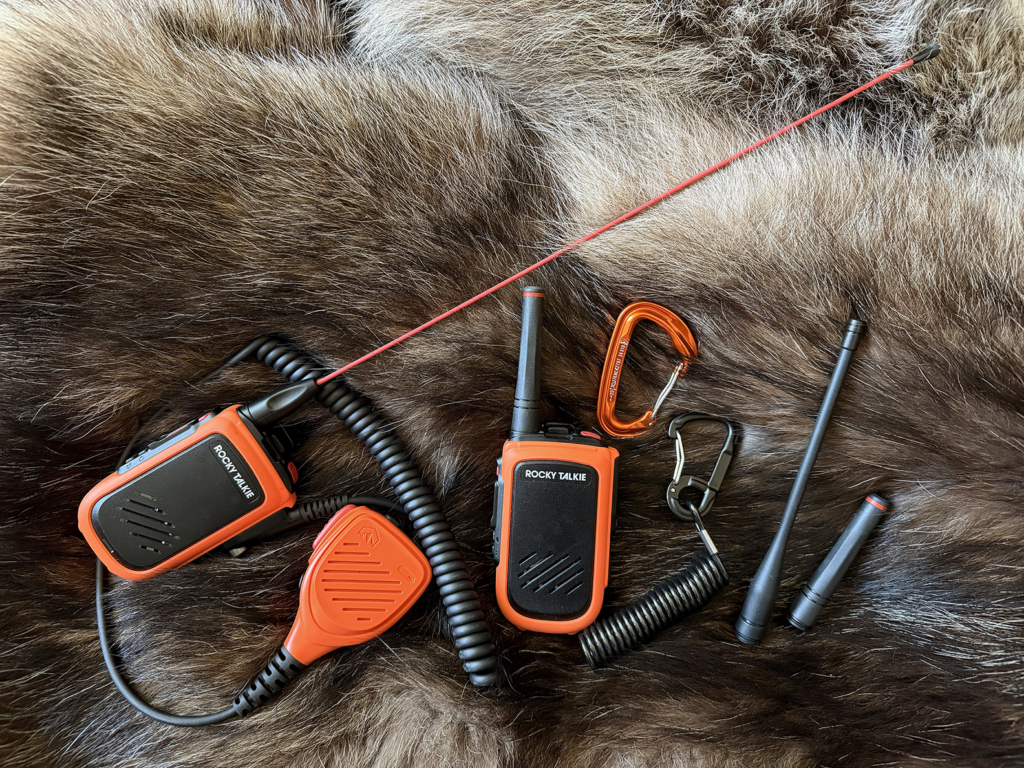
One of the big advantages the 5W Expedition offers over standard 2W radios you can get for cheap at any sporting goods store is the ability to switch to a stronger antenna, which increases your range. I picked up a UHF-GMRS whip antenna, which greatly extends the radio’s effective communication range. This extra boost allows messages to reach repeaters and then be transmitted to the other side of the mountain you’re on. Depending on terrain and conditions, it can increase your reach by up to 8 miles.
The steel alligator clip on the back of the Hi-Vis Orange Expedition Radios is strong and pivots 360 degrees, holding in place at eight locking points. This allows the unit to be securely clipped to a range of objects. Multiple mounting options are available to suit your needs.
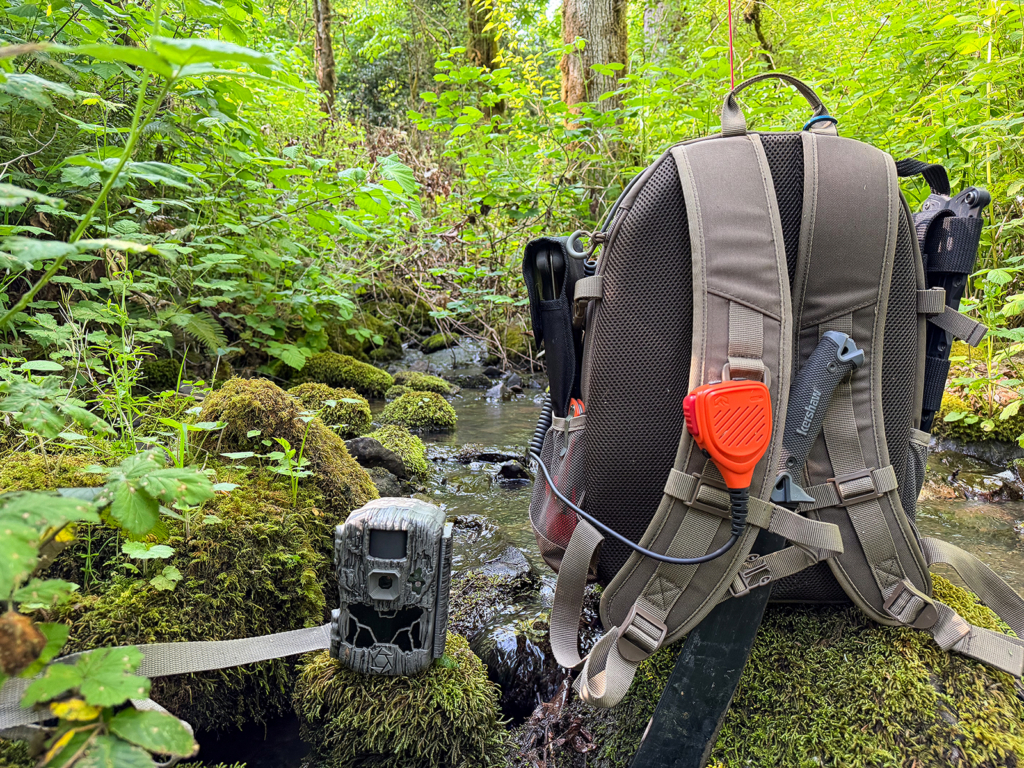
The more I used the Expedition 5W Radio, the more I found myself wanting a hand mic. I picked up the Waterproof Hand Mic For Expedition Radio, compatible with the Expedition Radio, also in Hi-Vis Orange. These are easy to install and operate. They also feature a steel alligator clip with 360-degree pivoting for secure, efficient access and operation.
Where the Hand Mic really shines is in the battery life and transmitting range. Depending on your usage, it will last 4 to 6 days. The radio is easy to recharge thanks to a versatile USB-C charging port.
In open terrain, the Expedition Radio has a range of up to 35 miles, and even beyond. Backcountry users in the mountains can expect a range of two to eight miles, while hunters in timbered hills can expect a reach of 0.5 to five miles. Rivers and bodies of water can dampen radio signal transmission, but the Expedition still reaches 0.5 to 3 miles across the water.
The unit has 22 channels and 121 privacy code options. It features a high- and low-power mode to conserve battery life, a scan mode, and, what I really like, access to NOAA Weather Channels. Simply scan the NOAA channels, and it will connect to the one in your area. This feature, alone, can be a game-changer. Not just for figuring out where and when to hunt, but also for getting out of the backcountry before a major storm sets in.
The screen is waterproof, scratch-proof, and tough. Because the screen is black and there are no indicator lights to show the radio is on, be sure to turn off the unit when not in use. Another tip: Lock your settings. The toggle switch that sits atop the unit actually protrudes slightly above the unit’s frame. I accidentally hit the channel toggle switch and changed channels. Simply locking the settings will remedy the issue.
The Expedition Radio can be submerged to a depth of 1 meter. I’ve had it in torrential downpours, and it sheds water very efficiently. All buttons and ports are sealed, so water and snow aren’t a concern. The radio’s temperature rating is -20º to 120º, serving hunters year-round.
The radios arrive ready to use, but you’ll want to become familiar with the options and settings. For this, refer to the Quick Start Guide that comes with the radio. I’d suggest putting this guide in a sealable plastic baggy and taking it with you the first few times afield, until you get familiar with it. You will not always have online access to answer your questions. Before heading out, be sure to visit the Rocky Talky website and watch their extensive YouTube channel for further help and clarity. Once set up, the unit is very user-friendly.
When it comes to the many places we hunt, cheap walkie-talkies don’t cut it. The Rocky Talky Expedition 5W Radio does, with impressive consistency. I’ll be using it on deer and elk hunts this fall, and taking it to Alaska on a moose hunt. As for the price point of the Expedition Radio, it’s a no-brainer. The full setup is a small price to pay for the potential to save your life.
Note: For copies of Scott Haugen’s popular line of hunting and fishing books, and Tiffany’s cookbooks, visit scotthaugen.com.