Though modern-day .410 bore shotguns paired with custom chokes and TSS loads extend your effective turkey range, that shouldn’t be the focus when you take a .410 shotgun turkey hunting.
by Scott Haugen
Four seasons ago, my father-in-law gifted me an old .410. It had been in his family since the early 1930s. He also gave me an old box of .410 shells. He thought it would be special if I could shoot a turkey with it.
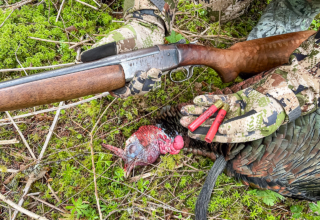
At first glance, I wasn’t sure the Winchester Model 37 would be safe to shoot because the upper end of the stock was broken. The rear portion of the firing pin was exposed. But everything else was tight and appeared to be in working order.
“I shot a gopher with it about 40 years ago,” my father-in-law told me. “Hasn’t been shot, since.”
I shot a couple of 2-1/2-inch light trap loads through the .410. The single shot gun held together, and no fire kicked back in my face. A good start for sure.
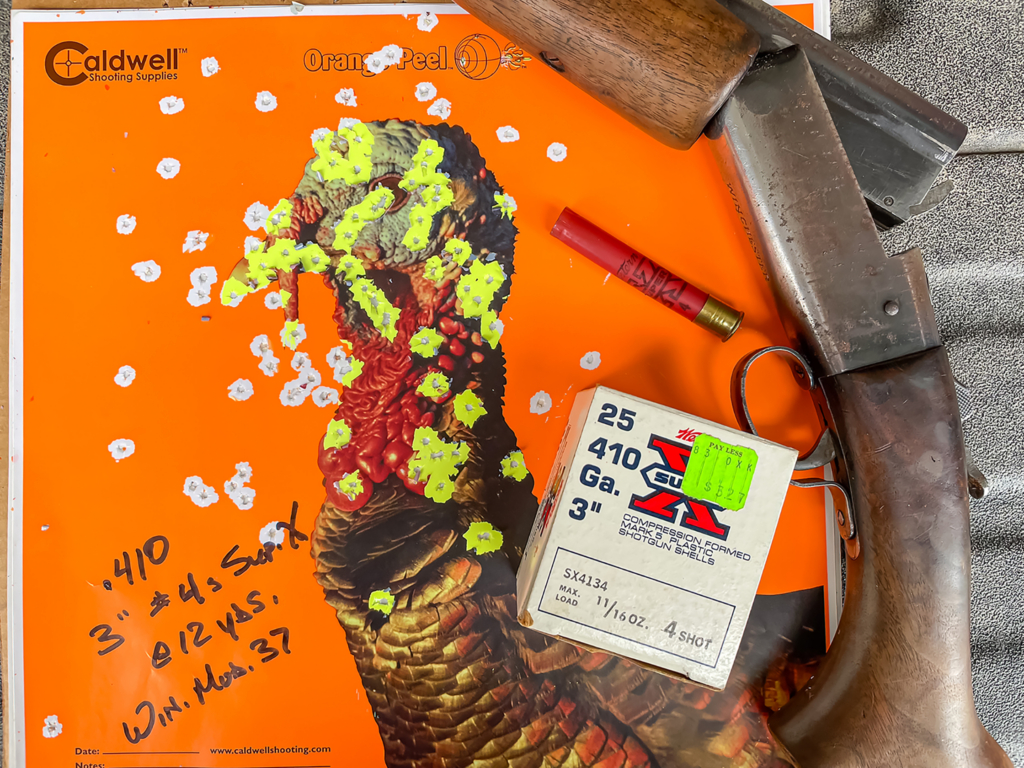
Then I grabbed some turkey targets and the shells I was gifted. The box of shells had never been opened. The Super-X 3-inch size #4 shot still carried a price tag of $3.27.
I shot a target at 20 yards and wasn’t impressed. I shot the next target at 10 yards. That pattern was more what I’d hoped for at 20 paces. Intent on knowing the effective range of the old setup, I grabbed two more turkey targets. At 15 yards, the pattern was close to what I’d hoped for. Then I shot a target at 12 yards. Bingo. That was the magic distance.
The Hunt
The process of setting up the old .410 was enlightening and forced me to think about how I would hunt with it. If I wanted to kill a tom using this vintage setup, the shot would have to be close. Twelve yards or closer, to be exact.
I chose an upright hen decoy to hunt the timber. I went without a blind in order to stay mobile. Should a tom hang up, or I hear distant gobbles, I wanted to be able to move.
I wanted to hunt the timber because of the cover it offered and because hens were nesting there. They’d feed early in the morning, then head for cover to sit on their eggs. Toms often followed them into the trees. It could be the perfect scenario to pull a tom in close. There were plenty of old-growth Douglas fir trees to serve as backdrops.
It took three days, but the plan finally came together. A single tom gobbled at my hen yelps. I called sparingly over the next 35 minutes. The bird never replied. Not until I saw its red head parting green ferns in the forest did I know the tom was approaching.
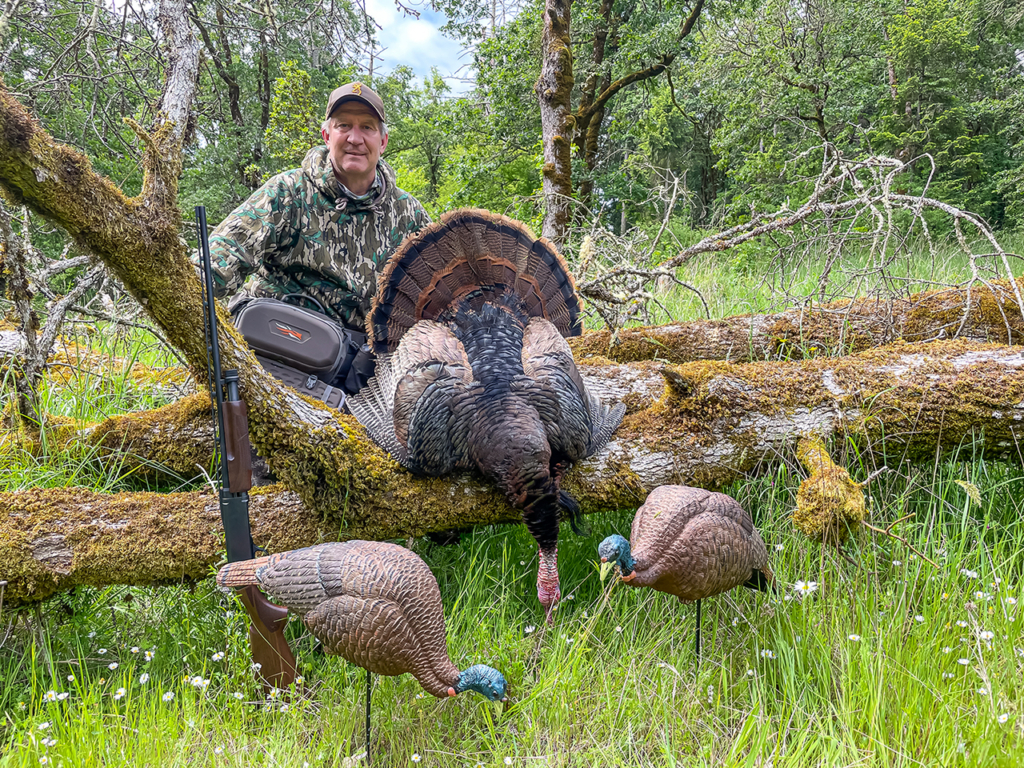
When the tom hit a deer trail and headed uphill toward the decoy, my optimism grew. The tom approached the decoy from behind, then strutted past it. When its feathers retracted and its neck stretched out, I fired. Exactly 12 yards away, the tom was dead. The task wasn’t easy. It required planning, strategic adjustments, and last-second decisions. It was fun. I learned a lot in those three days.
Though that was the first and last time I used the hand-me-down shotgun, I have turkey hunted with three other .410-bore models, all modern creations. Together, they’ve claimed nearly two dozen turkeys in both the spring and fall seasons.
The .410 Turkey Hunting Experience
After my old-school .410 experience, I felt as if I was catapulted into a time warp when handling modern.410 shotguns loaded with top-end loads. Right away, specialized chokes and shells entered the equation of optimizing each gun’s performance.
Because I’ve been chasing turkeys for 40 years, have penned some books, and written more magazine articles about turkey hunting than I can remember, I get asked a lot of turkey-related questions. The main one I get about using a .410 bore for wild turkey hunting is: How far can you kill a turkey with a .410?
If you’re asking the same, you’re missing the point of toting a turkey shotgun to the spring woods. I can just about promise you no inventors of .410s created them so they would have the lethal range of a 12 gauge. The .410 is a weapon of precision. One that requires elevated hunting skill to consistently attain kills, be it on the wing or head-shooting turkeys.
I love the performance of non-toxic shells, especially TSS, but my goal has never been to shoot a turkey at long range with a .410. Twenty-five yards was my preferred shooting distance with TSS, a custom choke, and a modern-day .410.
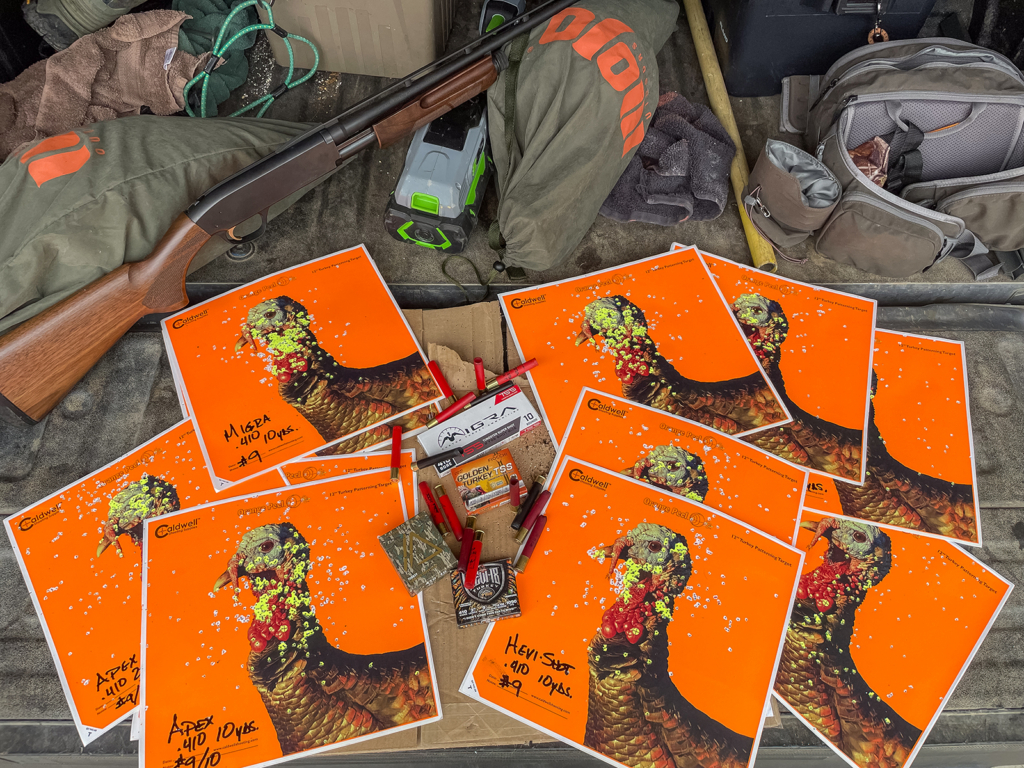
All three new-age .410 shotguns I’ve turkey hunted with can kill out to 40 yards—likely farther—but that wasn’t the goal. I wasn’t using a .410 because of its reduced recoil, lower noise, and lighter weight for carrying in the woods. I chose a .410 because accurate shot placement is required to consistently kill birds.
This season, we’re coming full circle. With the outrageous tariffs required to bring bismuth and TSS into the U.S., many hunters are going back to lead. News flash: lead still kills. Always has. And there are some great .410 lead loads out there.
I’ve shot two fall turkeys using Kent’s Ultimate FastLead in size 6 shot. I’m impressed with its performance. And at only $1.08 per shell, it’s not painful on the pocketbook. Some TSS loads are going for upwards of $12.00 per shell. Sticking with my goal of shooting a turkey inside 25 yards, I can just about be assured of shooting 12 birds with lead shells, compared to the price of shooting one tom with a single TSS shell. Smarter shot selection not only makes you a better hunter, but it also saves money.
The Education
It took me three outings before I fired a shot at a tom using the old .410 my father-in-law gave me. Had I been using my specialized 12-gauge magnum turkey shotgun with TSS loads and extra-full choke, I would have been able to shoot turkeys on each of the first two days. Toms came in both days, just not to the 12-yard standard I had set. What the experiences gave me was more time afield.
The only way to become a better turkey hunter is to spend time in the woods. Every day, every hour, every minute you’re in the woods hunting or scouting, you’re learning. It’s the acquisition of knowledge that takes our understanding of game to another level, and that’s what makes us better hunters.
When you commit to hunting with a .410, your entire mindset changes. Now, rather than hoping to get a tom on a decoy at 40 yards or fire an off-chance shot at 60 yards, you must bring a tom in close. To achieve this, the more you know about the birds and the area you’re hunting, the better the odds of success.
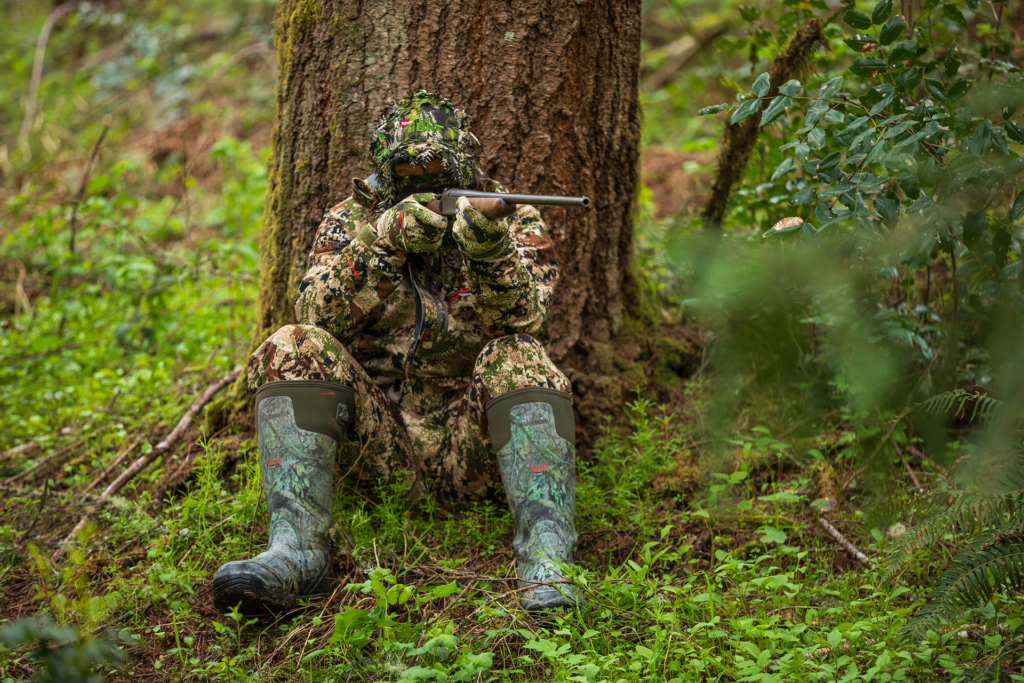
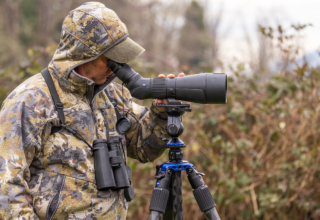
Scouting in person and running trail cameras are great starting points. Trail cameras set to video mode are game-changers. I currently have 89 Moultrie cellular cameras set in three states for turkeys. I can’t be in all these places at once every day, but the trail cameras can. Since late January, I’ve been monitoring hens, beardless flocks, jakes, and toms. Predators are also noted, especially bobcats, ravens, and owls, which kill many turkeys in my area. Each camera provides information directly related to whether the place will be huntable with a .410.
The Turkey Hunting Game Plan
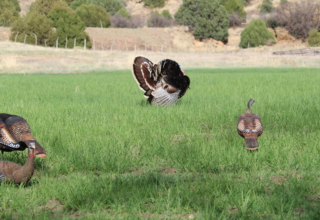
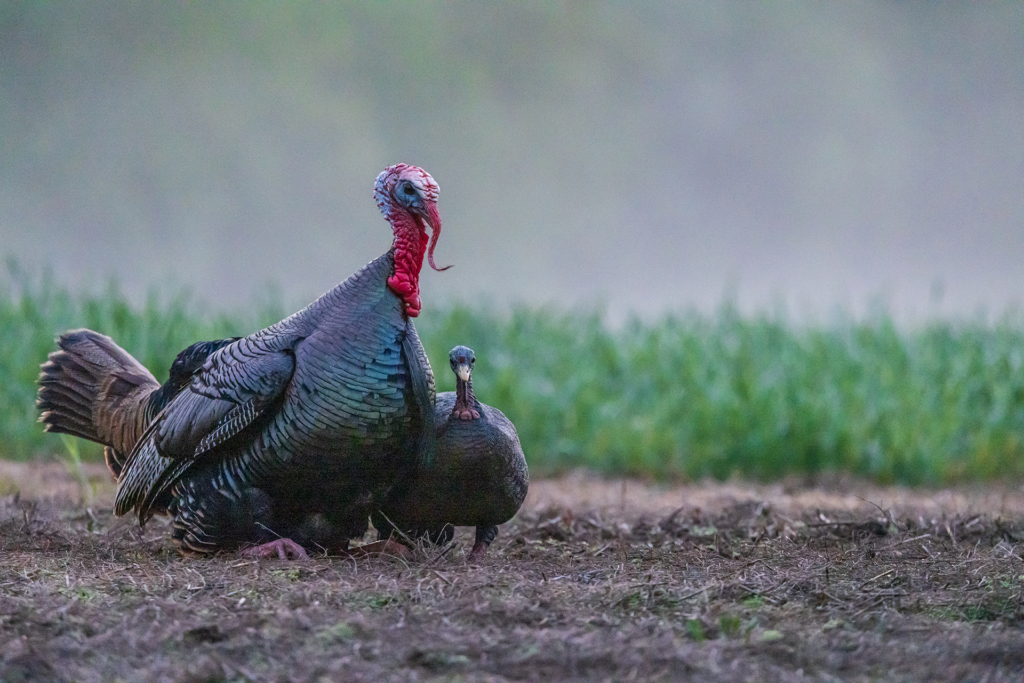
Once you have an idea of how many turkeys are in an area, their age classes, and what the tom-to-hen ratio is, then you can develop a game plan. If multiple toms are staying in one area, expecting hens to come to them, they could be challenging to call across an open meadow, into .410 range. But if you can sneak through trees to within 75 yards of where they’re strutting, then set up a lone hen decoy and offer subtle yelps, you might convince them to move in close.
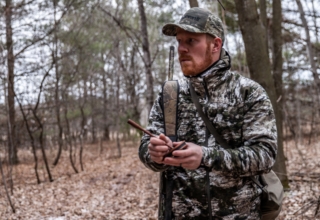
If a new tom shows up in the area, it might avoid the boys’ club. Newbie longbeards will likely travel trails inside the cover of trees in order to avoid a fight. Their goal with this incognito strategy is to bump into a hen. Again, a single hen decoy, light yelps and purrs, can be all it takes to bring this submissive tom into .410 range.
I have over a dozen styles of turkey decoys ready to use at a moment’s notice. Weather, predators, and other turkeys all impact my decision on which decoy to use. It could change daily, even by the hour. Knowing I want to get a tom inside 20 yards to shoot with a .410, I have to pay close attention to every detail.
I rarely use a ground blind when turkey hunting with a 12- or 20-gauge. However, with a .410, I know I might be sitting in areas longer, and a pop-up ground blind is nice. Whether I set up in the timber or on the river bottom, where toms could approach from any angle, a ground blind offers perfect concealment.
This spring marks my 40th season of turkey hunting. My goal isn’t to fill tags as fast as possible. My goal is to spend time afield, hunting and learning about the birds I love to pursue. Using a .410 has taught me a lot about turkeys and how to outsmart wise toms. Ultimately, I have these little bore shotguns to thank for making me a better turkey hunter.
Note: For signed copies of Scott Haugen’s best-selling book, Turkey Hunting The West: Strategies For All Levels, visit scotthaugen.com. Follow Scott’s adventures on Instagram and Facebook.