October’s last week doesn’t just mean costumes and candy. If you play your cards right, you might notch your whitetail tag.
by Jace Bauserman
October isn’t November. I’d be lying to you if I tried to convince you otherwise. I’ve never shot a deer on Halloween, but I have shot four mature bucks on November 1. Figure that one out…
Still, while my Halloween buck has avoided me this far, I have arrowed several respectable whitetail bucks during October final week.
Here’s what you need to know to find yourself lifting a heavy rack and posing for pictures before the calendar flips to November.
Use A Decoy
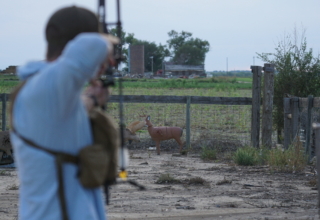
I’m an aggressive hunter; sometimes too aggressive, but that’s a topic for another article. During the last week of October, I often deploy my Flambeau Boss Buck Decoy. A large-bodied decoy with a smaller 8-point rack, this deer fake stands out, is easy to transport, and will get the attention of a ready-to-fight buck. My good buddy, Danny Farris, uses Dave Smith’s Posturing Buck. The decoy is expensive, but It’s ultra-lifelike and I’ve seen it produce excellent results for him.
Whether you’re sitting in a treestand or spending time behind some quality glass, pay attention to the goings on around larger agricultural food sources. Often, I will watch a buck nudge a few does around a field before heading off to bed. After the girls exit the field, I pull up my HuntStand app, pick a tree, and plan my approach.
Give yourself plenty of time getting in for the afternoon hunt. Whether you’re using a saddle or a small lock-on, you’re likely to make some noise. Plus, you may have to make two trips if you’re toting a stand, stick, decoy, and all of your hunt gear.
Take your time and keep the noise to a minimum. Before climbing up for your evening hunt, position the buck according to the wind. Bucks trust their noses more than any other of their senses. A buck will try to get downwind of your decoy. This is why paying attention to where bucks are likely to come from is so critical. You want the wind blowing from a buck’s forecasted travel route toward the stand.
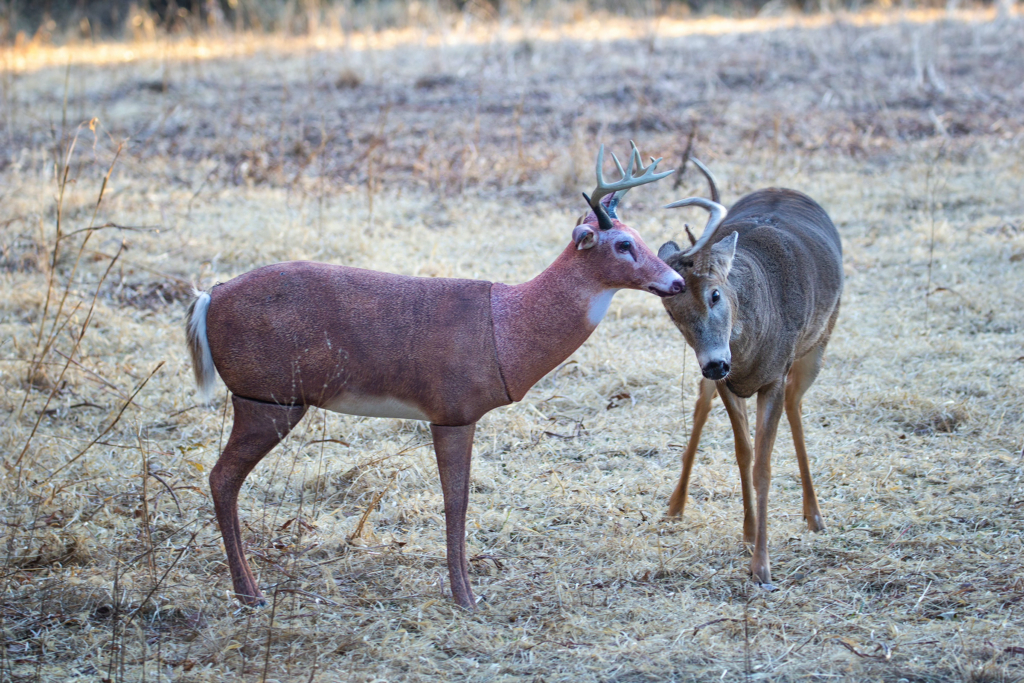
It’s also critical that you face the decoy toward, or at least mostly quartering to your stand. Mature bucks like to look another buck in the eyes. If you have your decoy facing toward your stand and set between 20 and 30 yards from it, an approaching buck will typically stop and inspect the decoy before making its final approach. This is the perfect opportunity to take a broadside or quarter-away shot.
If you’re planning to deploy an imposter during a morning hunt, you need to know the area well. Bucks don’t like getting surprised. They know how good their ears, eyes, and nose are, and they don’t like walking around a corner and seeing another buck standing 20 yards away.
You’ll want to put your decoy in an open area where bucks can see it from a distance. During morning hunts, I like open CRP pastures, timbered bottoms with open areas including isolated kill plots, so long as the plot isn’t so small you can shoot across it.
Call With A Purpose
There are two types of deer calling: blind and purposeful. Blind calling is when you don’t see a deer. Purposeful calling is when you see a deer.
During the final week of October, I sit on a lot of stands where I can see. Bucks seem extremely responsive to calling during this timeframe. If I see a buck in the distance that isn’t coming my way, I use my Quaker Boy Brawler Buck Call. I’m not sure what it is about this call, but deer love it. I’ve used the Brawler exclusively for 10 years and have called in so many deer with it. The rubber bellows between the acrylic mouthpiece and cone help the call produce deep, throaty grunts that bucks can’t ignore.

If I grunt at a buck and he stops but doesn’t start moving my way, I will typically try one more set of grunt sequences before picking up the horns. If it appears the buck can’t hear my grunt call due to the wind or his distance from me, I will go straight to the horns and try to get his attention.
Blind calling is also effective during the final week of October. Though I don’t recommend banging the horns together every 15 minutes for two or three hours, I will crack them about 30 minutes after sunrise if I haven’t seen a buck up on his feet.
When I hit the horns, I don’t do it lightly. I’ve never understood the “tickle ’em” theory. I bang bone when I clack it.
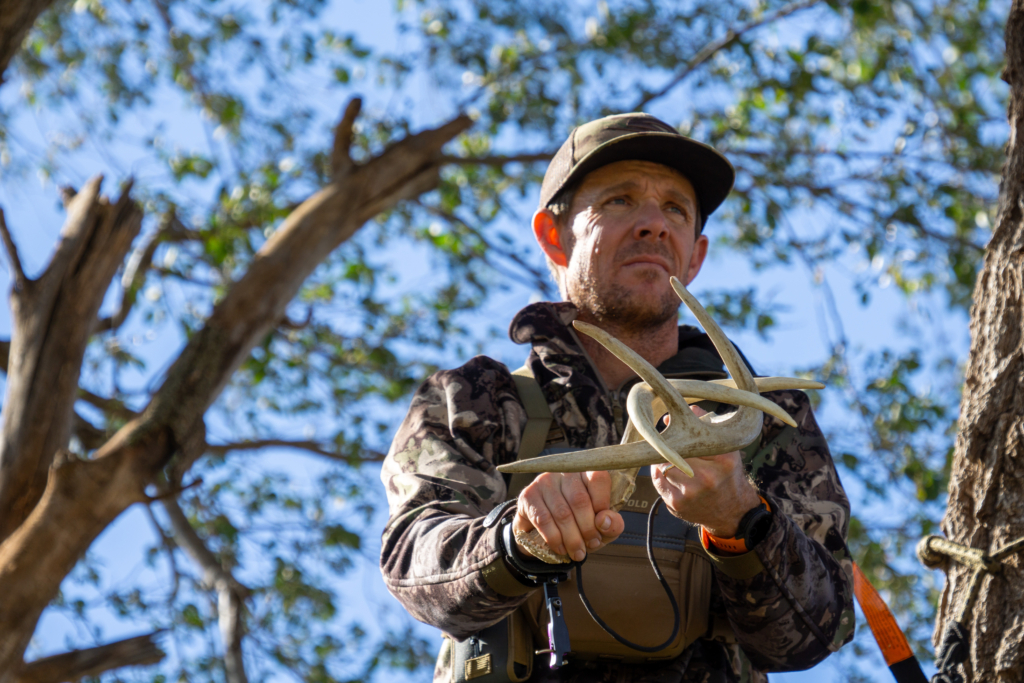
Late-October and early-November buck fights are ultra-violent. I want the sound to carry, and I like the sequence to sound natural. I keep up the clashing for close to a minute. Sound carries a long way if the conditions are right — not much wind and low humidity.
My good buddy and whitetail aficionado, Alex Gyllstrom, introduced me to rattling while hunting public ground in South Dakota many years ago. Before this hunt, I was anti-rattling, especially on public ground. That all changed!
Minutes after smacking the horns, the unmistakable sound of hooves walking through fallen leaves hit our ears. The buck hugged a cedar row, giving up nothing. He could have walked right through a grassy opening, but wanted to disguise his approach, keeping the wind as much in his favor as possible.
It was October 30, and though a 140-inch whitetail, his body language was non-aggressive. He was curious but didn’t come stomping in. Sadly, the buck busted me drawing. We needed a decoy to hold his attention, and the best tree for a stand put us a mere seven feet up.
Years later, on November 1, while hunting the famed Grigsby Farm in Illinois with my good buddy Mike Stroff, my cameraman and I watched a 150-inch 9-point chase two does back and forth across a standing bean field. The buck was 498 yards away. I double-checked the distance three times with my Leupold rangefinder. It was apparent the buck was rutting, and the second I clicked the horns together, he lifted his head and came on a run.

Rattling works so well during this time of year. Whether you’re blind rattling or see a buck you want to rattle at, clashing the horns together is usually not a bad idea. Bucks’ testosterone levels are through the roof, and during this phase of the whitetail rut, when they hear what they believe is two bucks locked in mortal combat, they assume the fight is over a lady, and they can’t help but investigate.
Doe Groups Matter
It’s easy to get frustrated, even during October’s final week. The moon may be perfect and Mother Nature may blow in a cold front, but remember, October isn’t November. While daylight activity is ramping up, it’s very possible not to have any does in estrus where you’re hunting.

If you’re seeing does during your sits and not seeing lone fawns wandering, chances are good that no doe is in estrus. The good news: At least one of the does is right on the brink. Hunt doe groups whenever you can. If you’ve got does showing regularly on an isolated kill plot, hunt that plot with the right winds. If you’re on a hot doe trail cutting through timber or off a waterway crossing, stay on it. Any day, a buck will be hot on the heels of those does. Even if one of those does doesn’t cycle, area bucks know where the local gals hang, and all of a sudden, you’ll look up and a buck will be coming your way.
Final Thoughts
Hunt hard during the final week of October. Extend your sits and resist the urge to climb down from the stand. If you can extend your sits by two hours in the morning and two hours in the evening, you’ll double your chances of running carbon through the lungs of a good buck.