The best test for any outdoor gear is putting said gear to the test in the woods. Here’s how Dead Air’s suppressors performed.
by Scott Haugen
Take the largest-bodied elk in North America, put it into the most rugged, densely forested habitat in the country where rainfall is measured in feet, not inches, and the stage is set for the ultimate test. And not just gear, but hunting skills, too.
Roosevelt elk test your patience. If the animals themselves don’t leave you feeling defeated throughout the course of a hunt, the habitat and harsh conditions will. Pursuing these elk in their coastal rainforest habitat will leave you doubting your abilities and questioning your gear. I know many hunters who’ve gone more than a decade without filling a Roosevelt tag, even though they hunt every day of the season. But sometimes, if you keep pushing hard, the tables turn.
“All the big bulls left about four days ago,” shared good friend and guide, Jody Smith, when two buddies and I arrived in camp on November 13. Smith and I have been good friends for nearly 30 years. We scout elk together, year-round. Together, we had over 50 trail cameras set on a piece of private timber company ground Smith has leased for over a decade. We’d been seeing lots of bulls, but the big ones vanished, as they often do this time of year.
A week earlier, Smith and I had located seven exceptional Roosevelt bulls on the land we’d be hunting.
“They’ve gone back into the Elliott, I’m sure,” Smith mumbled.
The Elliott is a state forest where logging hasn’t occurred in many decades. Here, Douglas fir trees several hundred years old climb into the clouds. Sword ferns grow over your head; they’re so tall, elk move beneath them, not through. And the brush is so dense, visibility is often only an arm’s length.
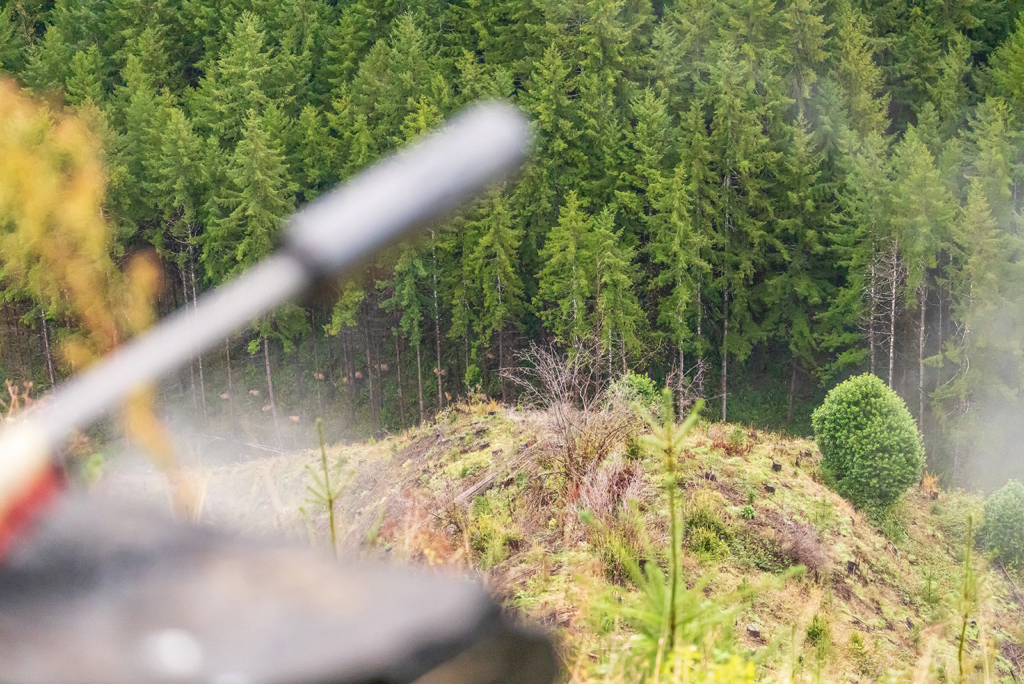
“I wouldn’t be too picky,” Smith said. “If we see a legal bull—three–point or better—you might want to consider pulling the trigger.”
In the first hour of the first day, Smith spotted an elk herd feeding in the bottom of a draw; a logged unit on one side, dense timber on the other. We counted over 40 cows and saw one small bull, a three-point.
“If they make it into the trees we’ll be hard pressed to get on them,” Smith noted, searching for a better bull through the spotting scope.
In minutes, the herd disappeared into the draw. “We have to hustle around the backside, see if we can catch them coming out,” Smith said, folding the legs of the tripod.
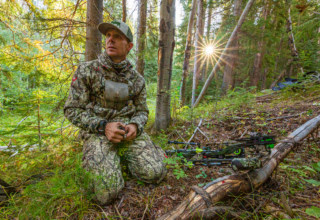
Bret Maffett, another hunter in our party, traveled from his Virginia home to hunt coastal Roosevelt elk. He and Smith wasted no time. After closing the gap, they crept over the top end of the unit. Elk were already shuffling into the timber. Then Smith found a bull. “It’s not a monster but it’s heavy on top, looks like a 5×5,” Smith whispered.
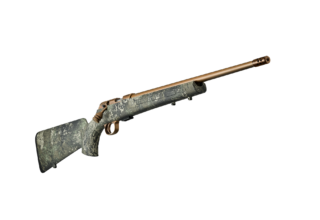
After slithering down the crest of the logged hillside, Maffett nestled his Benelli LUPO rifle atop a stump. At 186 yards, the 7mm PRC dropped the bull. It tumbled down the steep hillside to the bottom. Nearly five hours later, the four of us completed the packing job. Quartering and packing a Roosevelt bull is never simple.
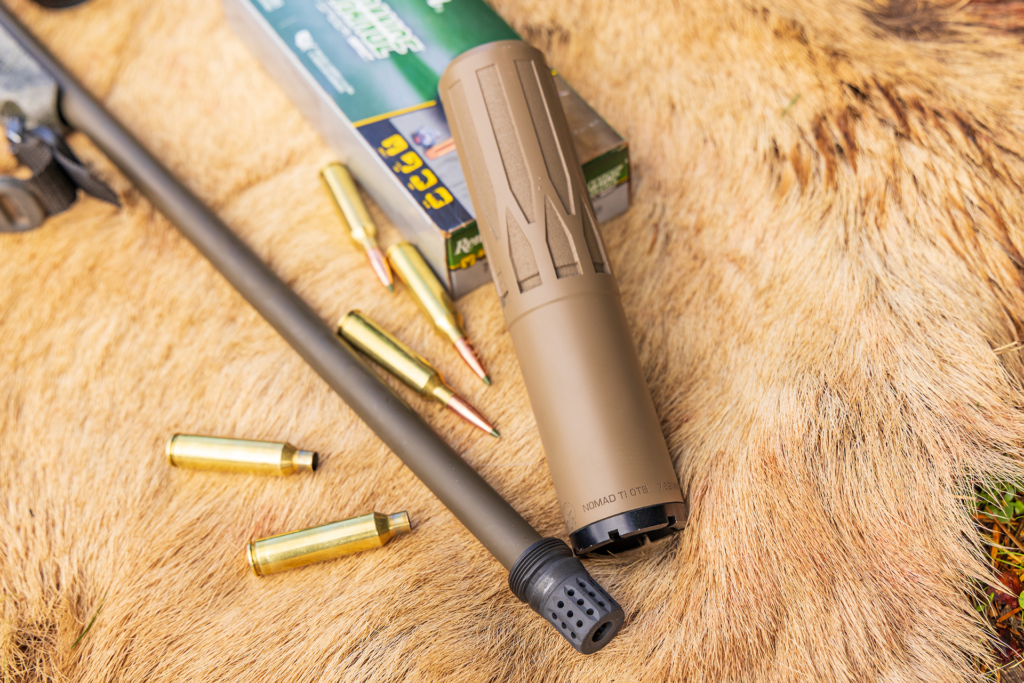
Maffett had just tagged his first elk. His LUPO rifle had a Dead Air Silencer. All three of us had the Nomad Ti Over The Barrel (OTB)Nomad Ti Over The Barrel (OTB) suppressor on our rifles. The best test of a suppressor is shooting an animal with others around it. Three cows grazed next to Maffett’s bull when he shot. Two of them jolted when the bull collapsed and rolled 30 yards to the bottom. They stopped by the third cow that hadn’t budged. When the bull came to rest, the cows looked at it for a while, then joined the rest of the herd. Eventually the entire herd slowly meandered into the woods. Not one elk ran.
That night, Dead Air’s Christian Chatellier—the third member of our party—explained the mechanics behind the OTB design.
“The Xeno Radial BreakXeno Radial Break that screws on to the barrel features a 45-degree shoulder with a sealed design. The Xeno Radial Break not only lessens recoil by about 20 percent, but it protects the black baffles and further reduces sound once the Nomad Ti OTB is installed.”
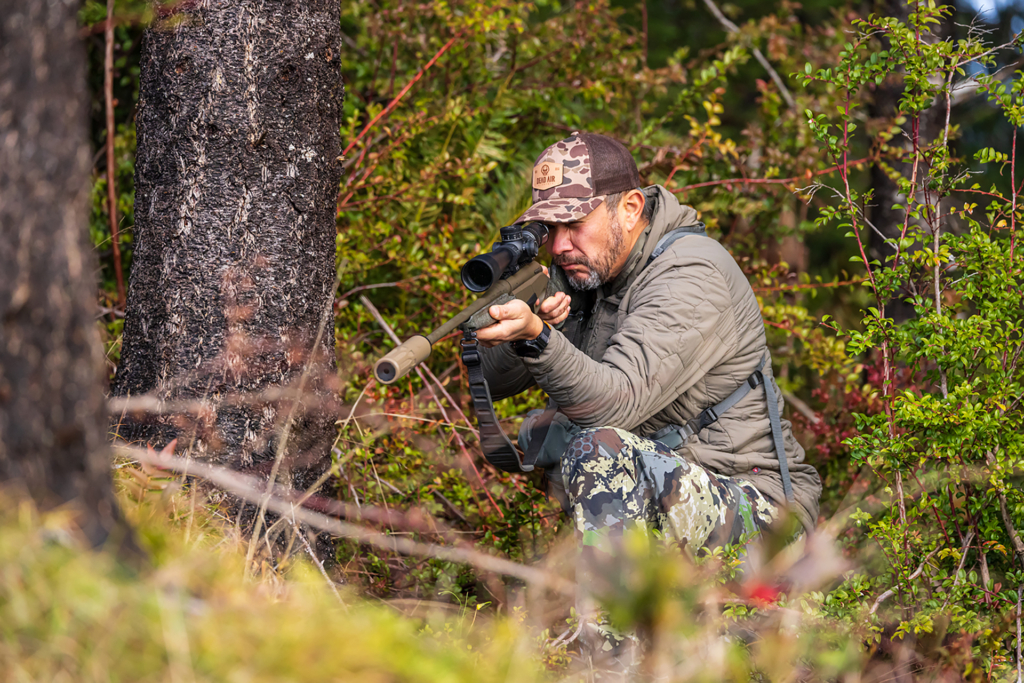
When Maffett’s bullet hit the bull, the impact was clearly heard. Before our hunt, I fired half a box of 175-grain Remington Premier Long Range ammo into paper through my LUPO 7 PRC. Within three shots, I dialed in the Burris Veracity 3-15×44 Veracity 3-15×44 scope, and the gun was shooting sub-one-inch groups at 100 yards.
I’ve been shooting illuminated reticles for over 25 years and instantly took a liking to this scope. What really caught my attention about the Veracity was the eyepiece focus ring. On some scopes I’ve shot, these rings bottom out, leaving the fiber optic dot fuzzy or misshapen around the edges. The eyepiece focus ring on the Veracity had a generous range, letting the glowing dot become tack sharp with no halo effect, no matter the shot distance or the habitat.
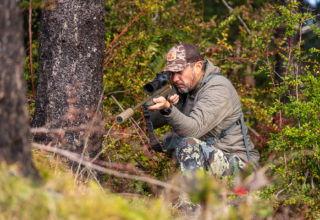
One morning, I headed into the Elliott State Forest, alone. I grew up hunting in thick cover and spend many days a year here. It poured rain, dumping nearly three inches. At one point I was on elk for over four hours straight. Much of that time was spent with my rifle in the tripod shooting sticks, picking out elk as they meandered through the forest. Some were within 25 yards of where I stood in the dark timber; others were 150 yards up the creek bottom. I spent the whole time watching elk, adjusting the scope’s power, illumination level, and eyepiece focal ring, searching for a good bull.
Late in the hunt, Smith and I found a bull on public land. He’d received a call from a logger buddy who saw the bull at first light. Smith knew the drainage the bull was in, but no matter how hard we searched, we couldn’t locate the elk.
“It’s either gone or right below us,” Smith whispered. Smith stayed put, glassing the draw, while I hiked up the mountain to get a better angle into the gulch.
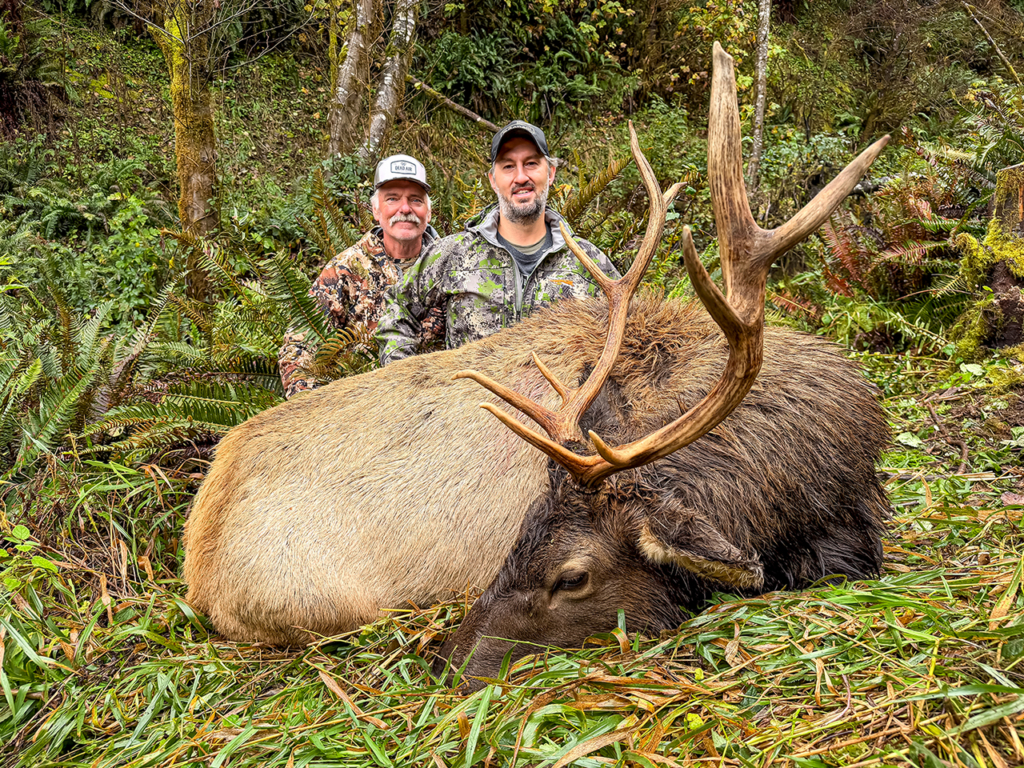
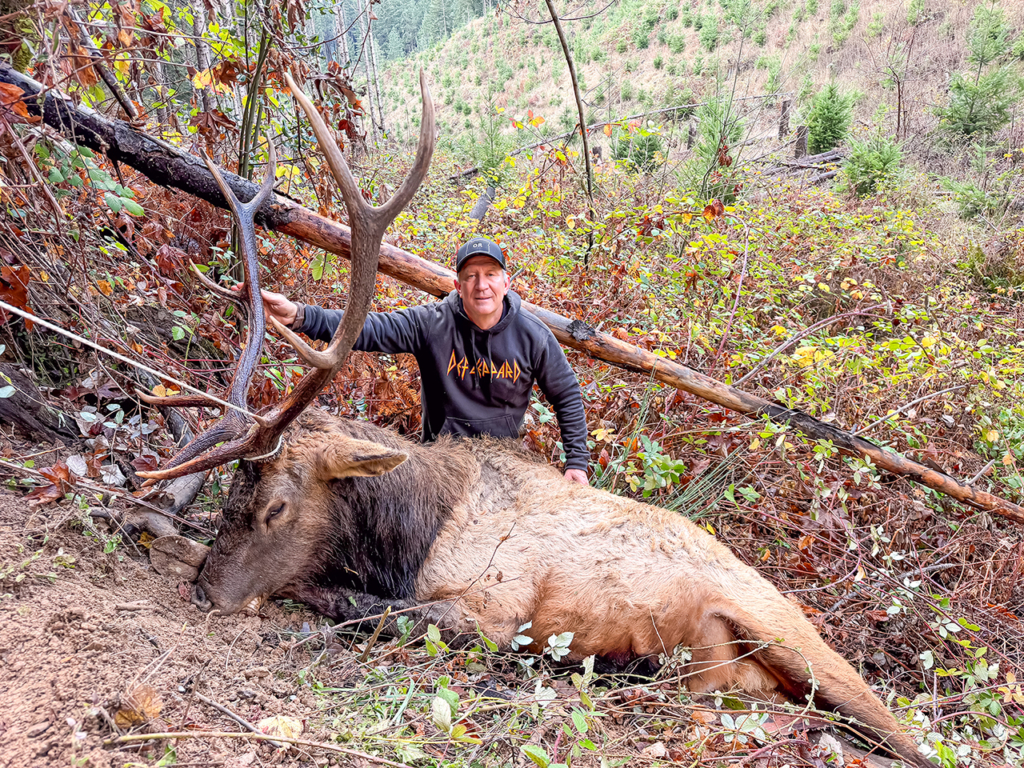
Ten minutes and 250 yards higher up, I finally got a narrow glimpse into the ravine. That’s when I saw the bull for the first time. It had heard me walking and made a run for the timber. The shooting window was brief. In less than three seconds, I fired two shots. The first was lethal; the second anchored the beast. I could clearly hear both bullets impact the bull, and so could Smith from where he stood. It was one of the biggest Roosevelt bulls I’d ever shot, and on public land.
When I shot the rifle on the range, I distinctly heard the suppressor doing its job. The sound that resonated from the barrel was a dull, comfortable compression of air; there’s no need for ear protection with the OTB. Then came a funneling sensation as the bullet traveled toward the target. At impact, a high-pitched tone was audible, then the air snapped to dead calm, followed by the bullet impact.
“We don’t care about decibels,” Chatellier shared when I told him about my experience shooting the Nomad. “Weather conditions, your surroundings, the elevation you’re hunting, even the ammo will impact decibels. Our suppressors are designed to achieve the right tone.”
His words made sense, and I saw it again.
Chatellier spotted a bull that emerged from the timber and began grazing in an open meadow. It was nearly 700 yards away. Using the forest edge for cover, Chatellier cut the distance to 127 yards. By the time he pulled the trigger, two more bulls joined the first. At the shot, Chatellier’s bull dropped. For over 10 minutes, the other two bulls continued grazing near the dead bull that had fallen less than 20 paces from them. It was the ultimate testimony to a well-designed suppressor. Chatellier was shooting a Benelli LUPO Model 15114Benelli LUPO Model 15114, also in a 7 PRC.
At the end of the hunt, we cleaned our rifles. When removing the Xeno Radial Break, all the carbon was above the 45-degree collar, confirming the tight seal and maximizing the suppressor’s performance.
When you shoot a setup that kills with efficiency, it’s hard to set it down. On this hunt, the rifle, scope, ammunition, and suppressor all performed to perfection, for all of us.
Note: Signed copies of Scott Haugen’s new book, Elk Hunting The West: The Experience, are available at scotthaugen.com