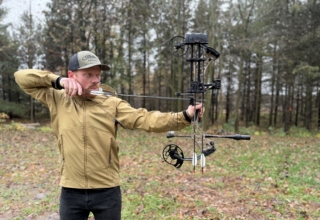
Mobbed with features and priced right, Bear’s new-for-2027 flagship, the Source, is sure to raise some eyebrows and fill some freezers.
by Darron McDougal
Off the top of my head, I can’t recall any past instances when a bow company launched a new flagship model at a lower MSRP than its flagship bow from the previous year. Leave it to Bear Archery to accomplish that feat. The 2027 Source has a $999.99 MSRP, whereas the 2026 Redeem was $1,299.99. That’s a difference of 300 bucks, folks.
But don’t worry; Bear didn’t trim a bunch of features and performance to achieve the price reduction. Quite the opposite, the Source is loaded with many of the same features as the Redeem, and it even has a slightly stabler 32-inch platform. It’s a high-end bow with a shockingly low price when compared to the market’s other flagship bows.
I recently had the pleasure of testing the Source. Here are some of the highlights I’d like to point out.
The Source Smokes
The Source isn’t a speed bow, per se, but it absolutely slaps. The test bow was set to 28 inches and 70 pounds, and with a 388-grain arrow, it shoots 302 fps. That’s 78.60 foot-pounds of kinetic energy. Based on that, I’m sure it lives up to its 340-fps listed velocity when set to 30 inches and shot with a 350-grain arrow. I bet you’re thinking the speed comes at the expense of a burdensome draw cycle, but that isn’t the case, which we’ll discuss next.
The Source Is Like Butter
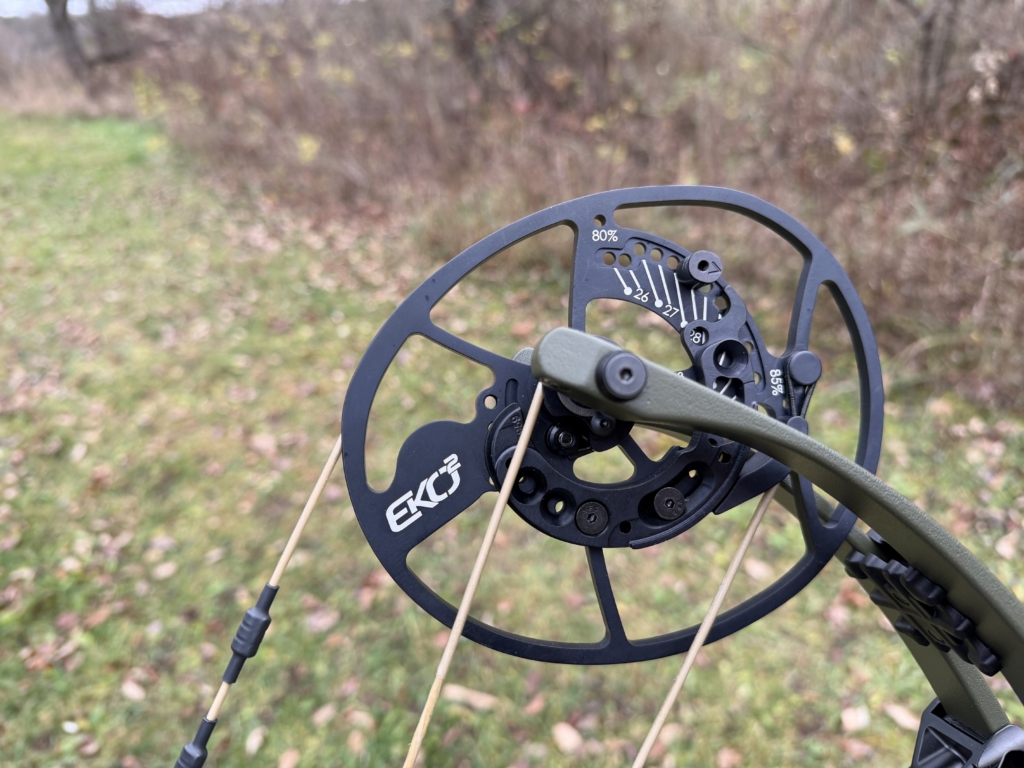
I know you’re not supposed to draw a bow back without an arrow nocked (and I certainly don’t suggest it), but I can’t help it. When I unbox new bows, I immediately handle them and draw them back. The Source, like the Redeem, features the EKO 2 Cam System, and to say that the 70 pounds slides back silky smooth is an understatement. The draw cycle is nice and even from start to finish with a pleasantly surprising transition from peak to valley — no obnoxious hump to get over. The cable stops provide a nice, firm back wall. I felt like I could hold the string at full draw forever; the cams aren’t jumpy. Letting down wasn’t a shoulder-jerk experience. Rather, it was a nice, easy process, which is a welcomed attribute in the field. A cam that hits as hard as the EKO 2 shouldn’t feel this good. Plain and simple, it feels awesome.

Simple, Effective Tuning
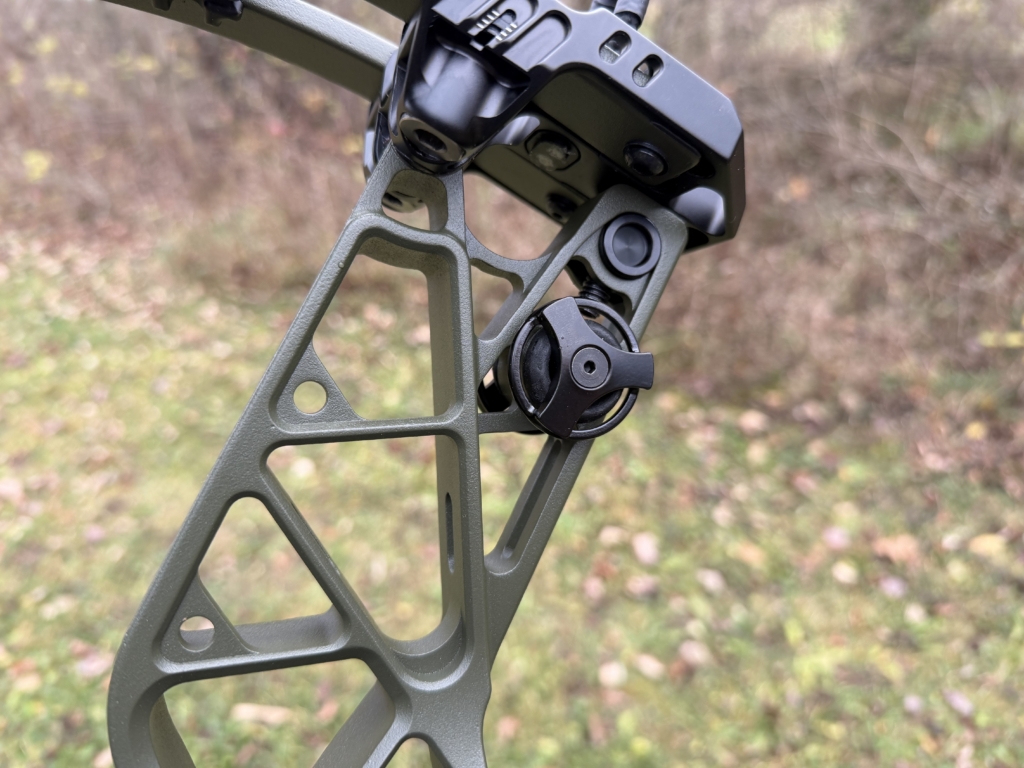
Bear inaugurated its Quad Pocket Control on last year’s Redeem. It’s a tuning system well differentiated from the market’s competing tuning systems. It’s back on the Source. The pockets are equipped with four rocker-style adjustments designed to adjust vertical and horizontal limb-weight distribution. Naturally, this adjusts cam alignment. The system is user-friendly and includes reference marks for tracking your adjustments. It puts tuning within the consumer’s reach, which is extremely convenient.
Integrative Accessories
I didn’t utilize them because I had minimal accessories available when the Source arrived, but the bow is equipped with direct-mount accessory attachment points. Bear calls the riser its Fully Integrated Riser. Like most modern bows, it has a Picatinny rail and IMS rest mount, but it also has the convenient Pull-Up Rope Loop, which is ideal for treestand and saddle hunters. Additionally, it’s loaded with In-Riser dampeners, and the shelf has a rubber pad to mute arrow contact. A rear sidebar mount, along with standard front and lower front stabilizer mounts, completes the ensemble. The riser is aesthetically pleasing to the eye.
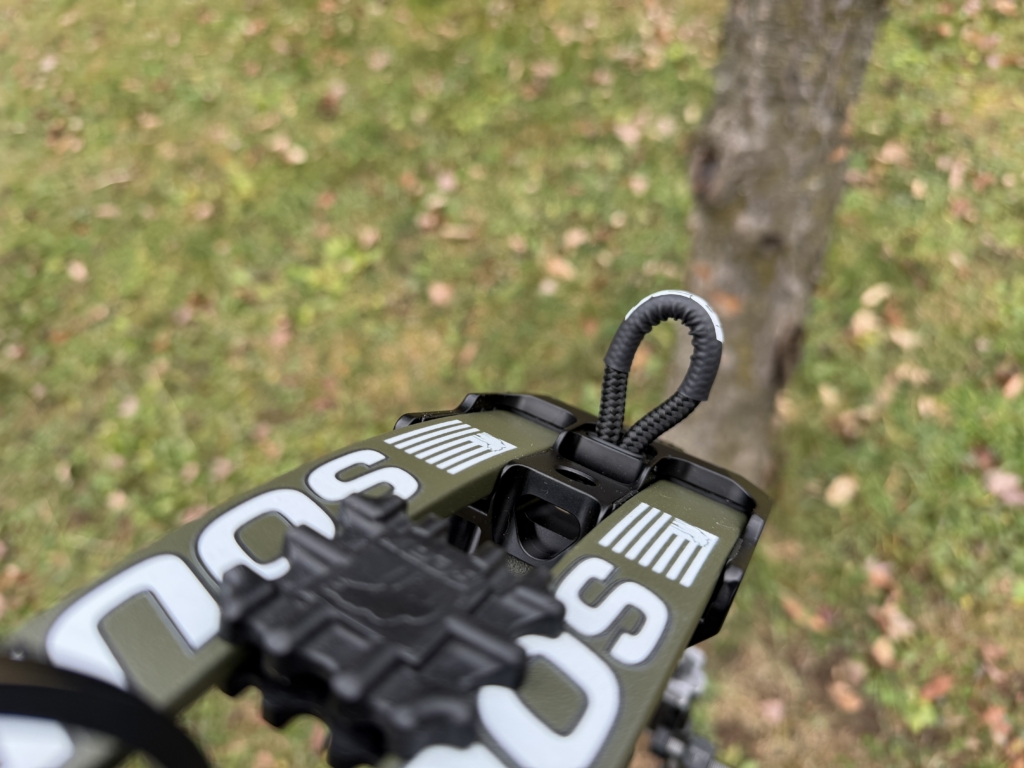
Bear did remove the bubble level that was mounted in the riser near the sight to assist with sight leveling. Bear also deviated from the Linear Tuning Roller (LTR) and rigged the Source with a conventional cable rod. However, the cable slide is equipped with rollers for both the cables and the cable rod, contributing to the friction-free draw cycle I mentioned earlier. It isn’t tunable to the degree that the LTR was, but it seems to work just fine.
Shooting The Source
I rigged the Source with an entry-level Whisker Biscuit rest and a CBE slider sight and spent some time shooting to note the bow’s fit, feel, stability and accuracy. It feels and aims well. It’s not the lightest bow ever, and if you’re looking for something lighter and are keeping your shots under 40 yards, Bear has other models to fit those bills. But if you want to shoot 40 yards and beyond and pack arrows together, you’ll appreciate the Source’s ability to anchor your sight pin. You can also move your front stabilizer between the two front mounts for a custom feel. And the rear sidebar mount puts more customization within reach.
The Source is also stealthy, which is the product of several silencing details. Parallel limbs help, of course, and the limbs are outfitted with dampeners. The In-Riser Dampeners also minimize vibrations, and a double-cushioned string suppression system minimizes string noise and oscillation. I wouldn’t call it the market’s quietest flagship bow, but for how hard it hits, Bear did a nice job with managing noise and vibrations.

I really like the grip. Its composite construction keeps your hand off the riser (ideal for cold weather), but it isn’t tacky. It’s also squared off on the posterior, lending itself toward a low-wrist gripping style. For me, it was easy to avoid torquing it.
Now, let’s talk about accuracy. I had minimal time to test the bow based on when it arrived and my busy fall schedule, but it shot where my pin was at 40 yards within minutes of setting it up. Shooting it accurately at 40 yards felt practically effortless. I plan to more definitive accuracy testing and stretch the bow’s legs when my hunt schedule slows.
A Few More Things
In summary, the Source is in many ways like the Redeem. The basic differences are the missing bubble level and the different cable guard. But it is two inches longer, solidifying stability. And again, it’s 300 bucks cheaper. Add to that a complimentary three-month onX Hunt subscription, and you’ve got yourself one heck of a deal.